SVOM Honored with the 2026 Scientific Excellence Award
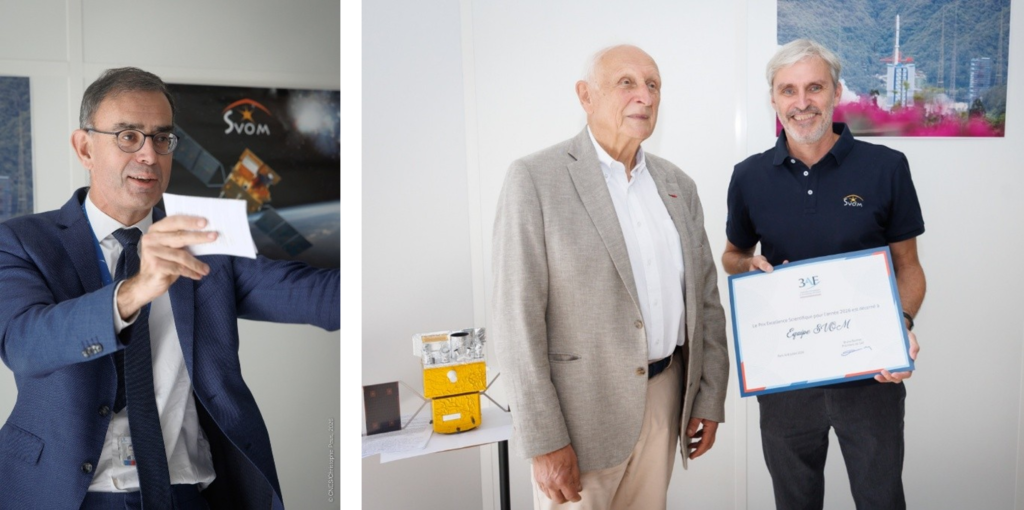
The SVOM space mission, dedicated to the detection and study of gamma-ray bursts, has been recognized by the French Aeronautics and Astronautics Association (3AF) with its 2026 Scientific Excellence Award. The award was presented on Thursday, October 1, at the headquarters of the French Space Agency (CNES).
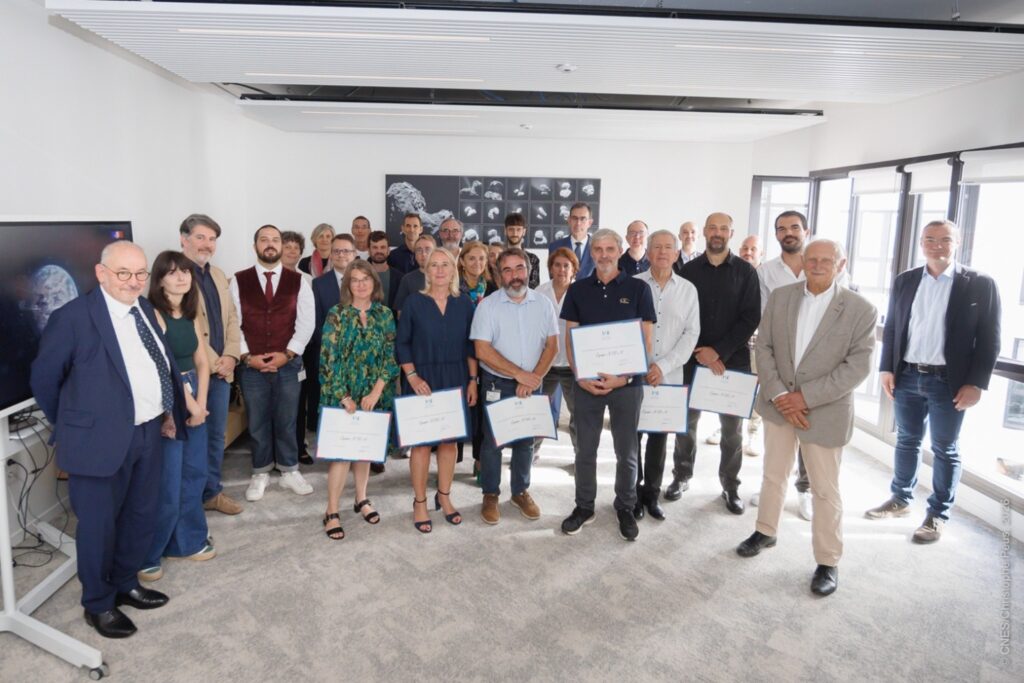
SVOM is the result of a collaboration between the national space agencies, the China National Space Administration (CNSA) and the French National Centre for Space Studies (CNES), with major contributions from the French Alternative Energies and Atomic Energy Commission (CEA) and the French National Centre for Scientific Research (CNRS).
Since its launch, SVOM has detected 358 gamma-ray bursts (GRBs) and has enabled distance measurements for more than 60 of them. A particularly remarkable event occurred on March 14, 2025, when SVOM detected and observed GRB 250314A, associated with the collapse of a star belonging to one of the earliest generations of stars. At the time of the event, the Universe was only 730 million years old. An observation by the James Webb Space Telescope (JWST) 110 days later revealed the associated supernova, making it the most distant supernova ever detected to date. Find out more: Happy 2nd Anniversary, SVOM!
The success of SVOM is the result of years of dedicated, day-to-day work carried out through close collaboration between French and Chinese teams of scientists and engineers. It illustrates how the close integration of space- and ground-based observations can push the boundaries of cosmology and multi-messenger astrophysics.
This award recognizes the high scientific quality and impact of SVOM’s scientific output.