GRB 261029A : a monster among monsters
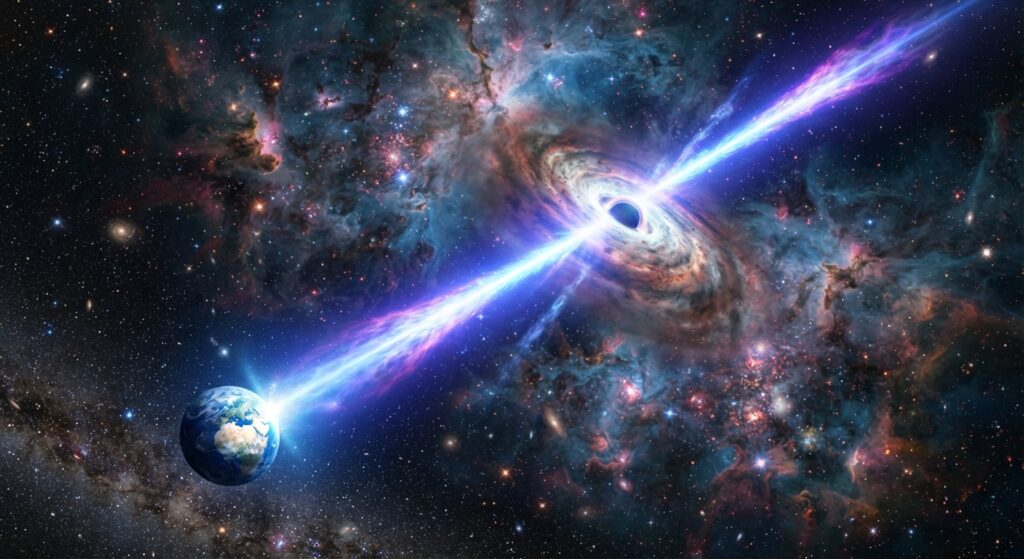
It is often stated that gamma-ray bursts (GRBs) are the most violent explosions in the Universe. These intense flashes of gamma-ray radiation are produced by black holes formed at the center of massive stars as they collapse at the end of their lives. For a few seconds, the newly formed black hole grows by accreting the stellar core at a rate of several thousand Earth masses per second. This extreme activity drives the ejection of two narrow, symmetric jets of matter, which carry enormous amounts of energy and propagate at nearly the speed of light (Figure 1). If one of these jets happens to be directed toward Earth, we observe a flash of X-ray and gamma-ray radiation known as a gamma-ray burst (GRB).
The energy released by a gamma-ray burst is estimated from the observed flux and the measured distance to the source. GRB 261029A, detected on October 29, 2026, by the ECLAIRs and GRM instruments aboard the SVOM satellite (see Figure 2), turned out to be both relatively bright in the two instruments and extremely distant, as determined from follow-up observations with the Nordic Optical Telescope in the Canary Islands (redshift z = 3.27). These measurements suggest that the burst released an exceptionally large amount of intrinsic energy.
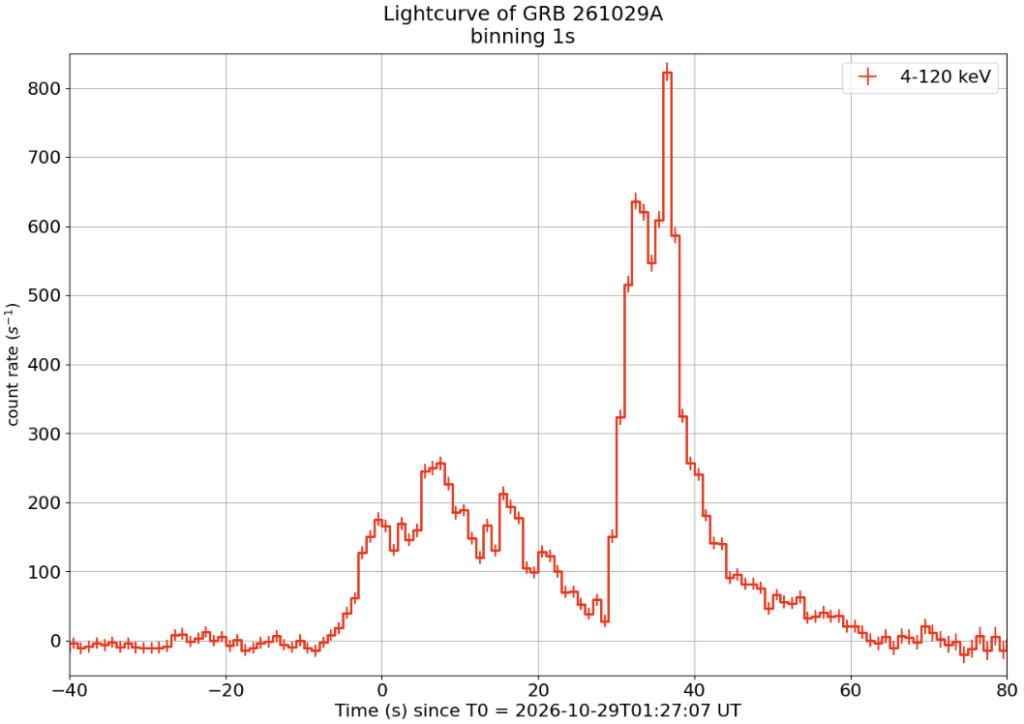
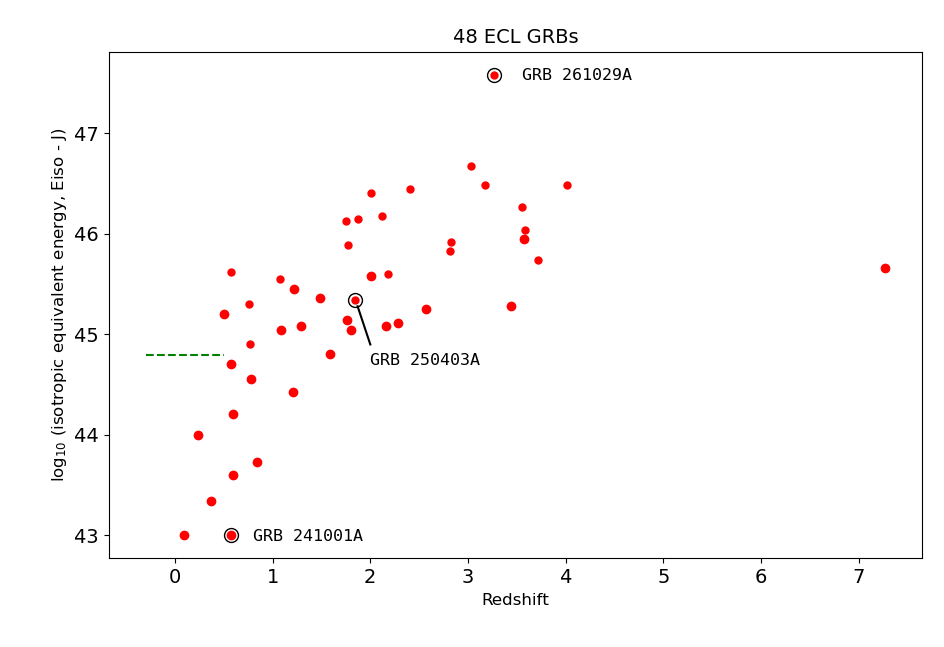
Detailed calculations confirmed this initial impression: GRB 261029A was found to be approximately 50,000 times more energetic than GRB 241001A, the least energetic gamma-ray burst detected by ECLAIRs (Figure 3; see also the news article “GRB 241001A: from the look of SVOM to the deep eye of JWST”) and 100 times more energetic than the powerful gamma-ray burst GRB 250403A (see the news article “GRB 250403A: proof of the phenomenal power of Gamma-Ray Bursts”). This places it among the 1% most energetic gamma-ray bursts ever observed. Such events are rare: SVOM had to operate for more than two years before detecting its first example. For comparison, the energy emitted by the Sun toward Earth over its entire lifetime (approximately 10 billion years) is represented by the green dotted line in Figure 3. As shown, GRB 261029A delivered toward Earth, in just about 30 seconds, an energy 500 times greater than that amount. Fortunately, the immense distance to GRB 261029A significantly attenuated the flux of radiation reaching us from this extraordinary explosion.
In the coming months, observations of GRB 261029A will be analysed from every possible angle to shed light on the physics of these extreme explosions. This will allow us to determine whether we have indeed witnessed an extraordinarily powerful explosion, or whether the energy emitted towards Earth depends on specific observing conditions, such as the orientation of the gamma-ray burst jet. Comparing this event with other bursts detected by SVOM will help us understand the physical processes responsible for the extreme power of these phenomena. At the same time, the visible emission produced by the violent interaction of the jet with the surrounding interstellar medium will also be studied in detail. This will provide valuable insights into the composition of the distant regions of the Universe through which the emission travelled during its 12-billion-year journey to Earth.
Contact: J-L Atteia