Svom detects one of the most distant bursts in the Universe and JWST observes the most distant supernova ever detected
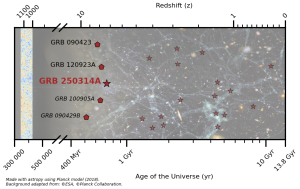
On March 14, 2025, the French-Chinese satellite SVOM (Space-based multi-band astronomical Variable Objects Monitor) detected an exceptional gamma-ray burst, named GRB 250314A, originating from the outskirts of the Universe. As soon the ECLAIRs and GRM instruments triggered, the satellite slewed and positioned its narrow-field X-ray (MXT) and visible (VT) instruments to observe this source, which—thanks to joint observations from several observatories and satellites, including JWST—turned out to be one of the most distant bursts ever recorded. GRB 250314A is a long gamma-ray burst, produced by the explosion of a star when the Universe was only 730 million years old, and whose light traveled nearly 13 billion years before being detected by our instruments. 110 days after SVOM discovery, JWST targeted the galaxy hosting this burst. Early photometric analyses suggest that it may be associated with a supernova resulting from the violent gravitational collapse of a massive star at the end of its life, closely resembling local supernovae of the same type. This result may indicate a surprising continuity in the explosion processes of massive stars (>20 solar masses), from the early Universe to the present day.
A flawless sequence
At 12:56 UTC, the SVOM ECLAIRs alert instrument detects a signal coming from the depths of the Universe and immediately issues an alert— the countdown begins. The operation starts immediately : the satellite reorients itself to observe the relevant region of the sky with its narrow-field MXT and VT instruments.

At 13:07 UTC, the Chinese GRM instrument confirms the detection.
At 13:23 UTC, the teams decide to send out a circular to alert the entire community.
The community on alert
Thanks to the alert transmitted by the burst advocates, other observatories step in to search for X-ray, optical, and infrared counterparts.
The Neil Gehrels Swift space observatory and the Einstein Probe satellite point their instruments toward the source. An X-ray counterpart is localized by the X-ray detector on board Swift. The Nordic Optical Telescope (NOT) discovers the near-infrared counterpart within the error box provided by Swift. Observations from Einstein Probe even confirm the transient nature of the X-ray counterpart— a key clue supporting the presence of a GRB afterglow.
On the SVOM side, however, the MXT and VT instruments did not detect a counterpart — an absence that may indicate that the event is particularly distant or heavily absorbed by surrounding gas and dust.
17 hours after the alert, using the precise position provided by NOT, the Very Large Telescope (VLT) equipped with its X-shooter spectrograph begins its observation. Very quickly, the observed optical/infrared spectrum shows a spectral shift corresponding to a redshift (z) of about 7.3. This measurement is then supported by photometric observations from the Gran Telescopio Canarias. GRB 250314A ultimately turns out to be the fifth most distant GRB ever identified. The previous GRB at such a high redshift (z > 7) had been identified roughly twelve years earlier!
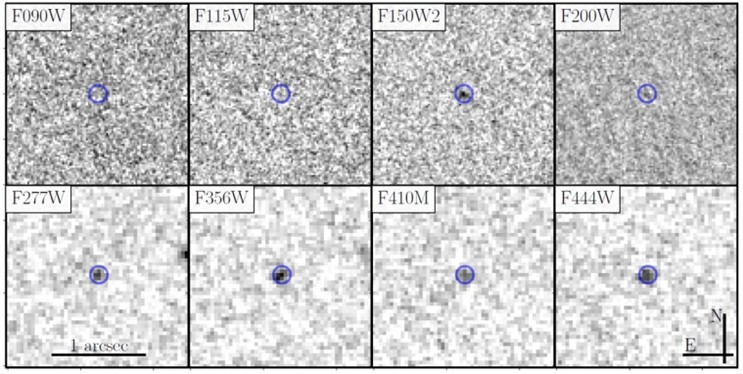
110 days later, the JWST satellite observes the burst position and, using its NIRCam instrument, detects an infrared emission. In the JWST images, the emission seen in the reddest filters is interpreted as the combination of the GRB host galaxy and the emergence of the associated supernova. An additional observation, already scheduled in nine months, should confirm the disappearance of the supernova.
A possible homogeneity of supernovae since the dawn of the Universe?
The photometric observations carried out by the JWST on the field of GRB 250314A demonstrate the satellite ability to observe traces of extremely distant stellar explosions. These early results show a strong correspondence with the well-known model of supernova SN 1998bw, associated with a nearby gamma-ray burst (z = 0.0085), GRB 980425. Beyond the fact that SVOM has enabled the observation of the most distant supernova ever detected (by far), this discovery suggests that the collapse mechanism of massive stars (the interpretation for the origin of long gamma-ray bursts) may be the same in the early Universe as in our local Universe, very close to us in both distance and time.
The supernova associated with GRB250314A is by far the most distant supernova ever detected. The following table provides a comparison of the most distant supernovae detected to date, with their respective redshifts.
| Event | Redshift |
Age of the Univers at explosion time (Gyr) |
Light travel time (Gyr) |
Comoving distance (Glyr) |
|---|---|---|---|---|
| GRB 250314A | 7,3 | 0,73 | 13,0 | 28,5 |
| SN 1000+0216 | 3,899 | 1,6 | 12,1 | 25,6 |
| DES16C2nm | 2,0 | 3,3 | 10,5 | 16,4 |
| SN UDS10Wil | 1,914 | 3,5 | 10,3 | 16,0 |
| SN SCP-0401 | 1,71 | 4,0 | 9,9 | 14,7 |
SVOM article : SVOM GRB 250314A at z ≃ 7.3: an exploding star in the era of reionization
JWST article : JWST reveals a supernova following a gamma-ray burst at z ≃ 7.3
The news in video by Andrea Saccardi (in French)
Contact: Andrea Saccardi