Swift’s last song
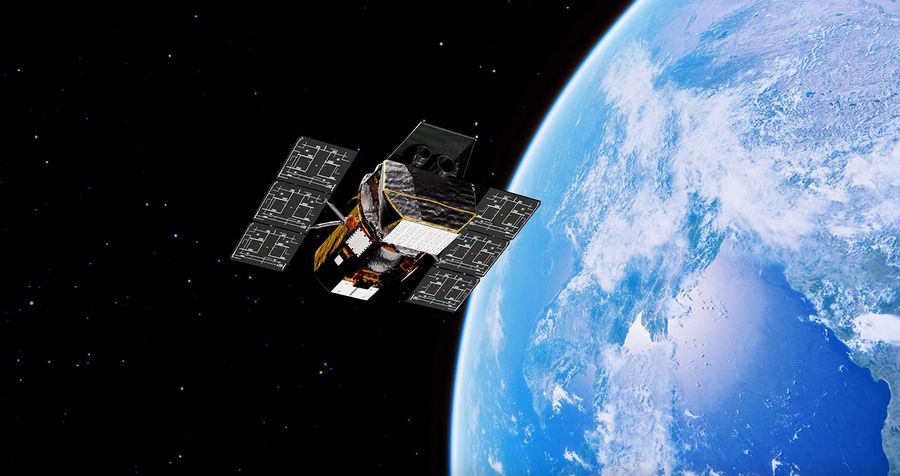
On Wednesday 4 November 2026 at 1.39 pm (Paris time), the Swift satellite re-entered Earth’s atmosphere whilst flying over Indonesia, after nearly 22 years in orbit searching for gamma-ray bursts. The Swift mission has truly revolutionised our understanding of the transient sky. This is an opportunity for the SVOM team to pay tribute to this mission and to look back on this close collaboration.
SVOM has benefited greatly from the support and expertise of the Swift team throughout its development. In early 2025, we successfully implemented an automated programme enabling follow-up observations with Swift of gamma-ray bursts localised by the SVOM/ECLAIRs telescope. Before Swift ceased operations, 57 follow-up observations had been carried out, enabling XRT to localise 30 X-ray counterparts with an accuracy of a few arcseconds. Combined with measurements obtained by the Einstein Probe, these observations also provided valuable information on the temporal evolution of the decay of afterglows, thereby contributing to a better characterisation of their properties for gamma-ray bursts detected by SVOM.
The precise localisations provided by XRT played a major role in determining the redshift for nearly 50 per cent of the gamma-ray bursts detected by SVOM/ECLAIRs. Since operations of Swift ended, this redshift determination rate has fallen to 35 per cent. It is worth noting that the contribution of Swift/XRT was particularly crucial in the case of high-redshift bursts, for which no optical counterpart can be detected.
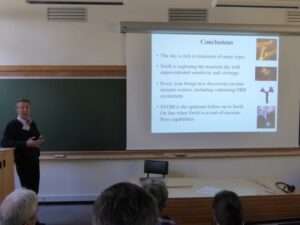
Today, Swift leaves behind a great scientific legacy that lives on through SVOM. The entire SVOM family extends its warmest thanks to the Swift team, whilst always remembering Neil with deep affection.