
Happy 2nd Anniversary, SVOM!
22 June 2026 marks the second anniversary of the SVOM satellite in orbit. The spacecraft was launched from the Xichang launch site in China at 07:00 UTC on 22 June 2024. Since then, it has completed more than 10,800 revolutions around the Earth.
Well-executed operations
Following a commissioning and validation period, the scientific operations phase officially began in April 2025.
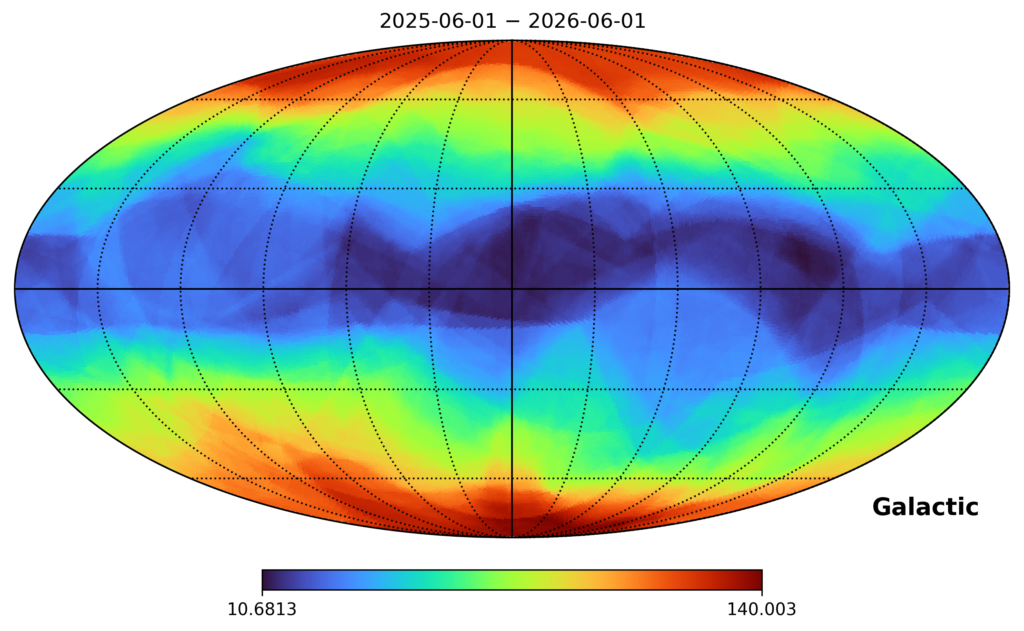
The map below shows the exposure time of different regions of the sky, expressed in Galactic coordinates, during SVOM’s second year in orbit as observed by the ECLAIRs telescope. The most highly exposed regions are the Galactic poles, in agreement with the attitude law defined for SVOM.
The following map shows the spacecraft pointing directions during SVOM’s second year in orbit, displayed in Galactic coordinates. The colours distinguish the different types of pointings:
- Blue: pointings associated with the General Programme, which consists of monitoring predefined regions of the sky while awaiting the possible detection of a gamma-ray burst. These observing regions are defined one year in advance and uploaded to the satellite every Thursday.
- Green: pointings corresponding to Targets of Opportunity (ToOs), i.e. observations of known astrophysically interesting sources that are scheduled rapidly from the ground, typically within less than one hour.
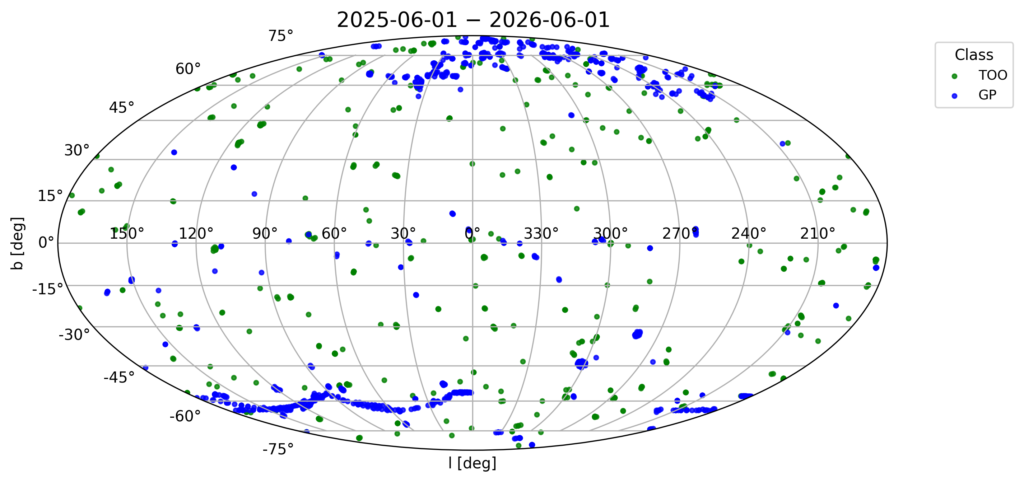
As soon as ECLAIRs detects and localizes a gamma-ray burst (GRB) in the sky, observations associated with either the General Programme or Targets of Opportunity are interrupted in order to focus on the burst. If the event is sufficiently bright, the satellite automatically slews to observe its afterglow for nearly eight hours in X-rays with MXT and in the visible band with VT.
Overall, during its second year in orbit, SVOM devoted:
- 7% of its useful observing time to the automatic triggering and follow-up of gamma-ray bursts;
- 60% of its useful observing time to General Programme targets. More than 1,170 pointings were performed on 130 different astrophysical targets, yielding a total of approximately 8 million seconds of scientifically exploitable data;
- 33% of its useful observing time to Target-of-Opportunity observations, of which 40% were dedicated to revisiting gamma-ray bursts detected by SVOM in order to continue building their optical light curves with VT.
The following map summarizes the transient sources detected by SVOM since the completion of the in-flight commissioning phase in September 2024.
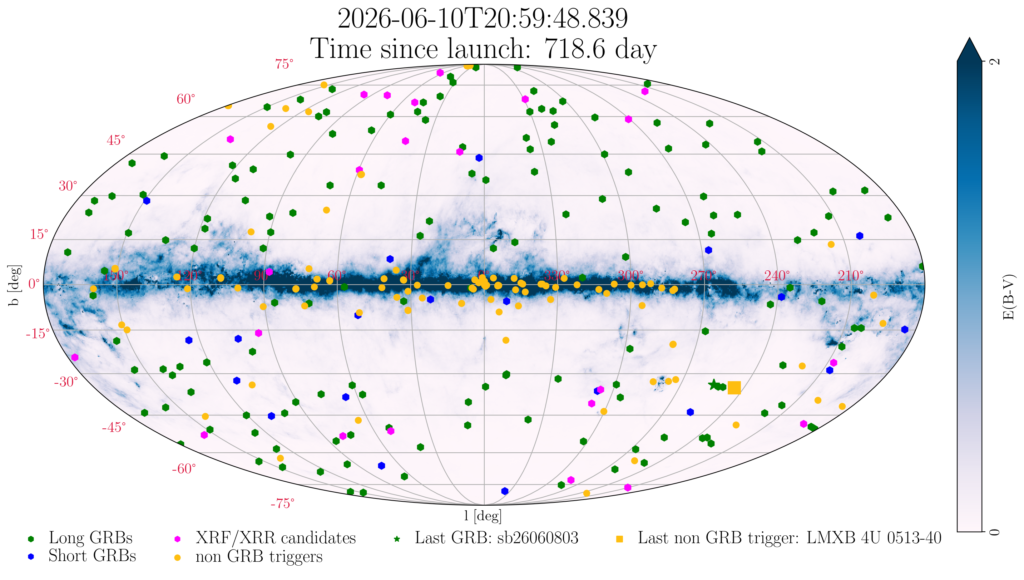
The strength of SVOM lies in its ability to detect and localize transient sources. Since the beginning of its operations, SVOM has detected more than 400 transient events characterized by short, high-energy emission. These transient sources are classified into two main categories: gamma-ray bursts (318) and previously known sources (96) that have exhibited bursts of X-ray/gamma-ray emission.
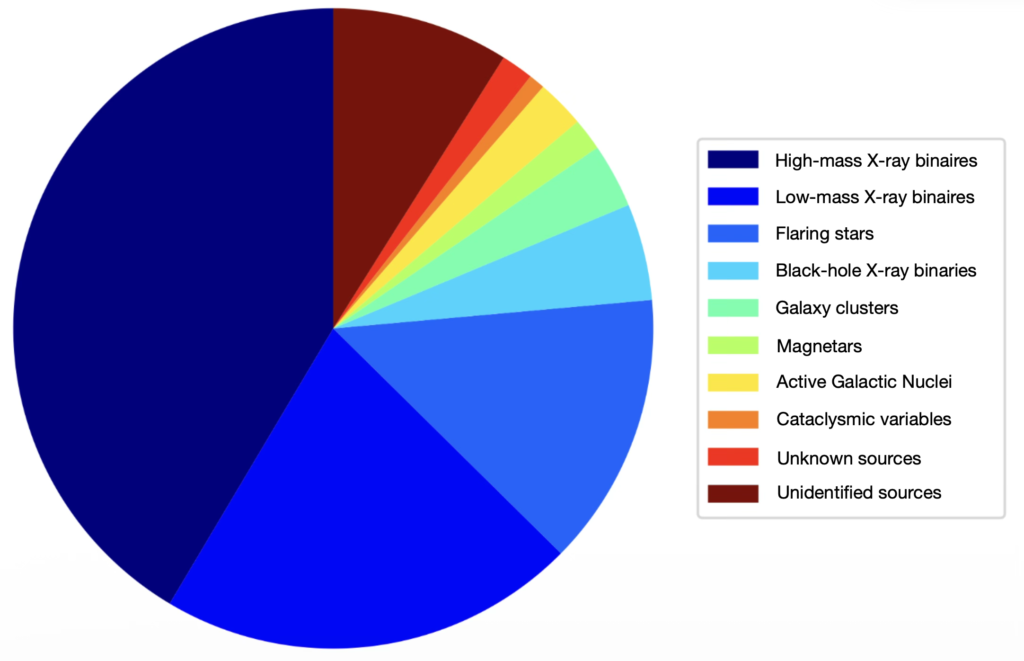
These known sources, shown in yellow, are predominantly located in the Galactic plane and encompass a wide range of astrophysical objects, including thermonuclear X-ray bursts from low-mass X-ray binaries, outbursts from high-mass X-ray binaries or active stars, black hole candidates, active galactic nuclei, and magnetars. The following figure illustrates this diversity.
The detection of these transient events has generated a large number of alerts to the international scientific community. In this context, the SVOM consortium has issued more than 800 GCN circulars on NASA’s platform to report the detection and follow-up of SVOM gamma-ray bursts.
Catalogued sources have also led to around thirty rapid publications in the form of Astronomer’s Telegrams.
A special issue of Research in Astronomy and Astrophysics dedicated to SVOM is currently in preparation. This issue brings together a comprehensive set of 34 articles describing the mission, its system, its instruments, and its first scientific results. The articles are available on arXiv here.
The science of gamma-ray bursts
Since the beginning of the mission (as of 12 June 2026), SVOM has detected 318 gamma-ray bursts, including:
- 270 detected by GRM
- 107 detected and localized by ECLAIRs
Thanks to the responsiveness of the SVOM system and multi-wavelength follow-up by our partners, among the 107 bursts localized by ECLAIRs, 79 gamma-ray bursts were observed in soft X-rays, 66 were observed in the optical band, and redshift measurements were obtained for 40 events.
A new population of bursts
A key strength of SVOM lies in its ability to fully characterize a significant fraction of gamma-ray bursts, from prompt emission to afterglow, including distance determination, host galaxy identification, and searches for associated supernovae.
After only two years of operation, SVOM is revealing a population of X-ray–rich bursts that had been only partially uncovered in the early 2000s by previous missions such as BeppoSAX and HETE-2. These bursts are primarily characterized by prompt emission dominated by X-rays, while releasing energy amounts comparable to those of long gamma-ray bursts associated with the collapse of massive stars. The following figure illustrates the contribution of SVOM.
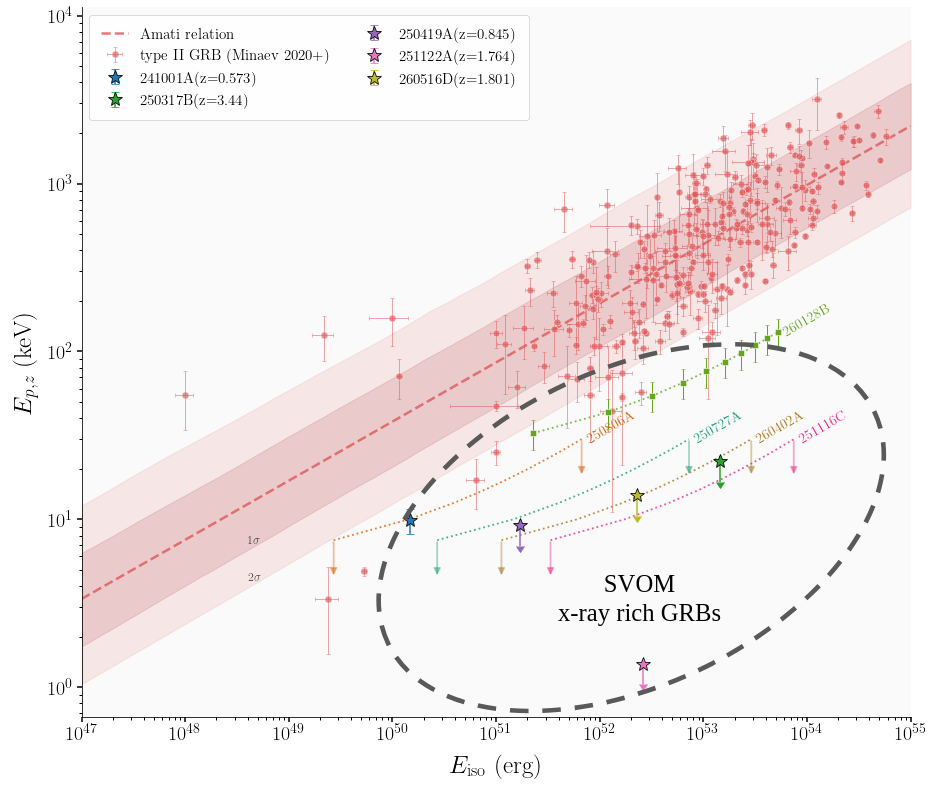
Preliminary multi-wavelength observations of the X-ray–rich bursts detected by SVOM nevertheless reveal an unexpected diversity of properties, suggesting that several astrophysical scenarios may be responsible for these explosions. Are these ultimately “classical” gamma-ray bursts observed under specific physical conditions, or do they represent a new class of stellar explosions?
Thanks to its enhanced sensitivity to the softest transient phenomena, SVOM is opening a new observational window on stellar explosions and their immediate environments, with the potential to uncover entirely new classes of yet-unknown cosmic event.
SVOM and the primordial Universe
SVOM also makes a significant contribution to the study of the early Universe.
On 14 March 2025, the SVOM satellite detected an exceptionally distant gamma-ray burst, designated GRB 250314A. Thanks to the rapid localization provided by its ECLAIRs instrument, astronomers were able to promptly trigger an extensive follow-up campaign involving numerous ground-based and space telescopes.
Subsequent analyses showed that this burst originated from the very edge of the observable Universe. Its measured redshift of approximately 7.3 indicates that the explosion occurred when the Universe was only about 730 million years old, corresponding to barely 5% of its current age. Since that event, the emitted light has travelled for more than 13 billion years before reaching us, being progressively stretched by the expansion of the Universe.
GRB 250314A is currently the third most distant gamma-ray burst ever spectroscopically confirmed. It is also the first event detected at such an extreme distance in more than a decade. This discovery is particularly valuable as it probes a still poorly understood epoch in cosmic history: the era of reionization. During this phase, the first generations of stars and galaxies began to illuminate the cosmos and profoundly transform the matter filling the Universe. The intense ultraviolet radiation produced by these early massive stars is thought to have played a major role in this transformation. Observing a gamma-ray burst from this epoch therefore provides a direct probe of the physical conditions in the primordial Universe.
GRB 250314A thus offers an exceptional witness to the death of a massive star occurring less than one billion years after the Big Bang.
This interpretation was further supported by observations from the James Webb Space Telescope (JWST) in July 2025, which revealed the presence of an associated supernova. This finding confirms that massive stars already existed at such early epochs and ended their lives in extremely powerful explosions.
Beyond its scientific impact, this detection fully demonstrates the potential of SVOM to explore the distant Universe. By pushing the boundaries of observability, the mission opens a new window onto the formation of the first stars, the emergence of the first galaxies, and the major transformations that shaped the cosmos shortly after the Big Bang.
Beyond GRB 250314A: has SVOM discovered other distant cosmic explosions?
While GRB 250314A is the first high-redshift gamma-ray burst confirmed by SVOM, marking the explosion of a massive star in the young Universe, the mission has also identified several events that may originate from similarly remote cosmic epochs.
In several cases, SVOM and its partners have detected X-ray afterglows and rapidly obtained deep optical observations using the VT visible telescope. When a clear X-ray counterpart is observed but no optical afterglow is detected despite stringent observational limits, the burst becomes a particularly compelling high-redshift candidate. At extreme distances, ultraviolet and optical light from the afterglow is absorbed by neutral hydrogen along the line of sight, rendering the source nearly invisible in the optical band while remaining detectable at longer wavelengths.
Since the launch of SVOM, eight candidate high-redshift gamma-ray bursts have been identified. However, none of these events has yet been confirmed with a sufficiently robust redshift measurement, and their nature therefore remains uncertain. The following figure illustrates SVOM’s contribution.
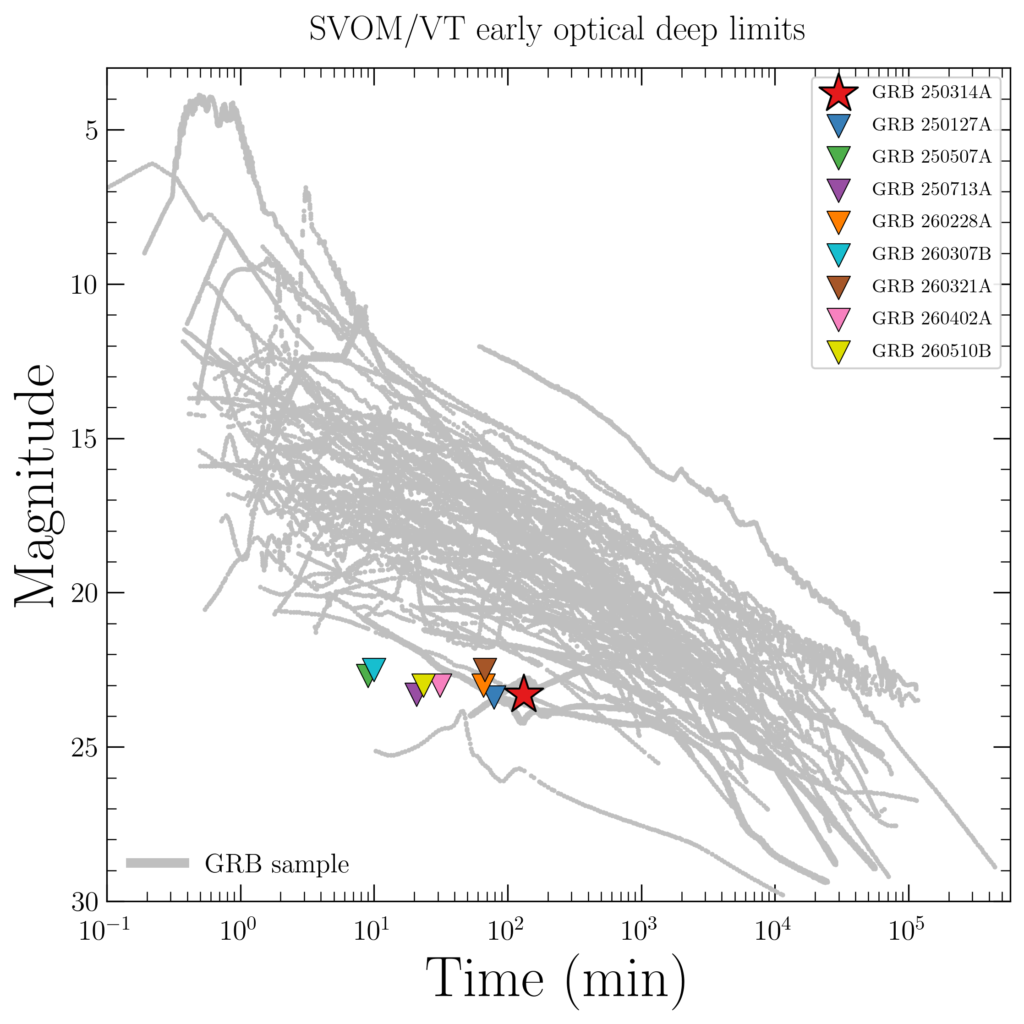
To resolve this ambiguity, rapid follow-up observations in the near-infrared are essential. Even when the optical signal is strongly attenuated, afterglow emission can still be detected in this spectral range. Near-infrared photometry and spectroscopy therefore constitute key tools for determining whether these bursts originate from the first billion years of the Universe’s history.
Future follow-up strategies are expected to significantly improve the identification of these rare events. A major advance is anticipated with the installation, at the end of 2026, of the CAGIRE camera at the focal plane of the Colibrí telescope (FM-GFT). This new instrument will strengthen an already limited network of facilities capable of providing rapid near-infrared follow-up of gamma-ray bursts.
Publications
The Gamma-ray Burst Science working group currently has 4 papers published in peer-reviewed international journals, and 35 scientific projects are ongoing in various stages of analysis and preparation.
The Observatory Science Programme
Although its primary mission is the detection and study of gamma-ray bursts, SVOM has rapidly proven to be a versatile observatory capable of monitoring the entire high-energy variable sky. This is precisely the purpose of the Observatory Science programme, which is dedicated to all other classes of transient and variable sources.
Discoveries across astrophysics
Among the notable results is the detection of oscillations during a Type I thermonuclear burst from the binary system 4U 0614+091, an important finding that demonstrates the sensitivity of the ECLAIRs instrument for probing the surfaces of neutron stars (for more information).
These oscillations, observed between 10 and 60 seconds after the trigger, exhibit a frequency drift attributed to the orbital motion of the neutron star, providing an unprecedented constraint on the properties of this system.
SVOM was also the first instrument to detect the X-ray flare of the blazar 1ES 1959+650 in December 2024. Blazars are galaxies whose central nuclei host supermassive black holes that launch plasma jets moving at nearly the speed of light and, by chance, oriented directly toward the Earth. These sources undergo sudden and intense flaring episodes whose underlying mechanisms remain poorly understood. The rapid detection of this flare by ECLAIRs enabled the initiation, within a few hours, of a coordinated multi-wavelength campaign lasting several weeks and covering an unprecedented spectral range from the optical band to hard X-rays. The study of this event revealed complex particle-acceleration mechanisms within the relativistic jet and is reported in a publication in Astronomy & Astrophysics (Foisseau et al., 2026).
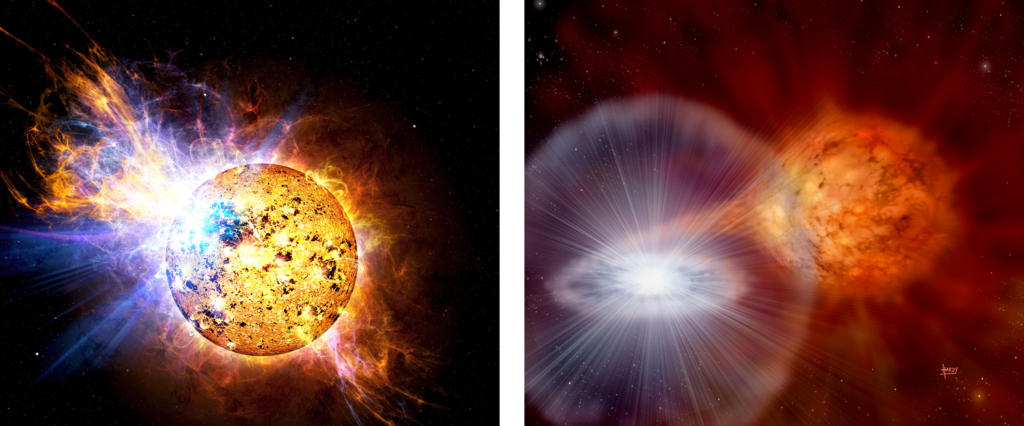
In the field of stellar physics, SVOM observed a giant flare (superflare) from the star HD 22468, detecting hard X-rays together with spectroscopic signatures of chromospheric evaporation, a phenomenon in which plasma heated to more than 100 million degrees is expelled outward from the stellar atmosphere, releasing a total energy of the order of 10^38 erg (J. Wing et al., ApJ, 2026). Understanding such flares has implications that extend far beyond stellar physics, as these events may profoundly alter the atmospheres of planets orbiting these stars, with direct consequences for their habitability. Thanks to its wide-field instrument ECLAIRs, SVOM is particularly well suited to systematically detect such events—a scientific domain that was not necessarily among its original objectives, yet one in which it is already emerging as a leading facility.
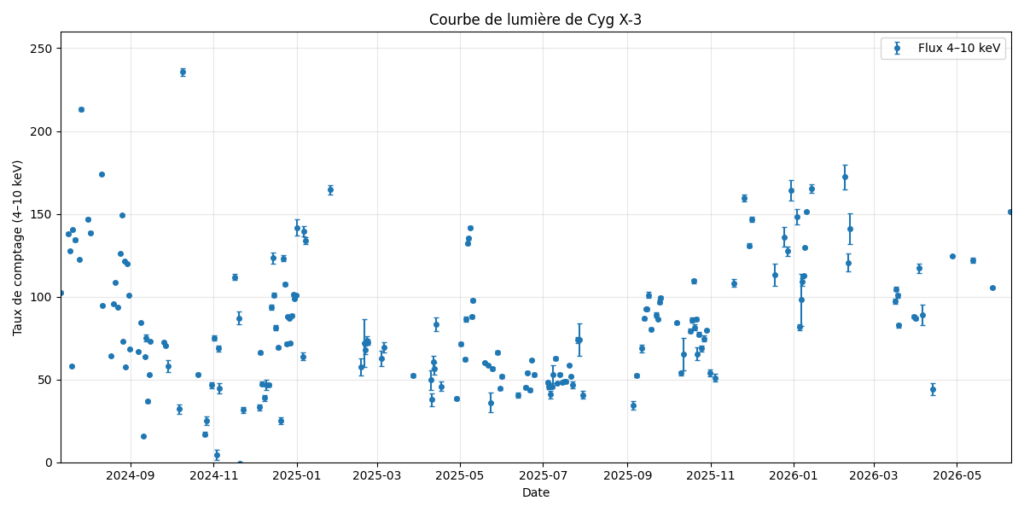
SVOM also monitored in real time the entire spectral-state transition of the neutron-star X-ray binary Aql X-1 during its 2024 outburst, demonstrating its capability to track the evolution of accreting systems. X-ray binaries consist of a companion star and a compact object (a neutron star or a black hole) accreting material stripped from its stellar partner. Among these systems are microquasars, whose compact objects are generally thought to be black holes. SVOM therefore conducted a dedicated monitoring campaign of Cygnus X-1 and Cygnus X-3, accumulating more than 75 days of exposure and producing joint MXT+ECLAIRs spectra as well as highly detailed light curves of these iconic systems.
Publications
The Observatory Science working group currently has seven papers published in peer-reviewed international journals, two manuscripts under review, and one paper undergoing internal review within the SVOM Collaboration. These studies cover a broad range of topics, including thermonuclear bursts, blazars, stellar physics, and X-ray binaries. In addition, about twenty other scientific projects are currently under analysis within the working group.
A General Programme Open to the Scientific Community
On the occasion of its second anniversary, SVOM is preparing its second call for observing proposals (scheduled for summer 2026, for observations to be carried out in 2027), inviting astronomers worldwide to request observing time on this unique observatory by contacting members of the collaboration.
Thanks to its rapid response capability, the complementarity of its onboard instruments, and its growing synergies with partner facilities such as Einstein Probe, SVOM is establishing itself as a cornerstone of multi-messenger and time-domain astronomy for the years to come.
Authors: B. Cordier, A. Coleiro, N. Dagoneau, A. Saccardi, and D. Turpin.