
Svom Observes a Thermonuclear Explosion on a Neutron Star
Shortly after the start of its scientific operations, the SVOM space mission demonstrated its full potential by detecting a spectacular phenomenon: a thermonuclear X-ray burst from the celestial source 4U 0614+091. This observation marks an important milestone for the mission, showing its ability to study not only distant gamma-ray bursts, but also violent phenomena occurring within our own Galaxy.
4U 0614+091 is a binary system located in the Milky Way in the Orion constellation about ten thousand light-years from Earth. It consists of a neutron star, an extremely dense object formed from the explosion of a massive star, and a companion star. This system is very compact, meaning the two stars are extremely close to each other. Under the influence of the neutron star’s extraordinarily intense gravitational field, matter from the companion star is gradually stripped away and accumulates on the surface of the neutron star. When this material becomes sufficiently hot and dense, it suddenly “ignites,” triggering a thermonuclear explosion observable as an intense burst of X-rays lasting several tens of seconds.
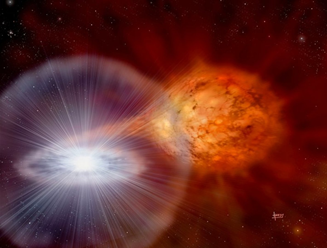
On January 10, 2025, the ECLAIRs instrument aboard the SVOM satellite detected such a burst from 4U 0614+091. This rapid detection confirms the excellent sensitivity of the instrument and SVOM’s ability to monitor the X-ray and gamma-ray sky in search of transient events in the plane of our Galaxy. But the scientific interest goes beyond mere detection: a detailed analysis of the light signal reveals valuable information about the neutron star itself.
Using modern signal analysis methods, researchers were able to study very faint oscillations present in the burst, completely invisible to the naked eye. These oscillations are very likely linked to the neutron star’s rotation on itself, at a dizzying rate of more than 400 revolutions per second. Their detection thus makes it possible to directly measure the neutron star’s rotation speed and to explore the extreme physics of its surface, where matter is subjected to conditions unattainable on Earth.
But the analysis does not stop there. Data from the ECLAIRs instrument also reveal a gradual decrease in the frequency of these oscillations, an atypical behavior compared with similar phenomena observed in other binary systems by previous missions. Although the exact origin of this evolution is not yet fully understood, the scientific team suggests that it could be the signature of the neutron star’s orbital motion around its companion. According to this interpretation, the system’s orbital period would be less than 20 minutes.
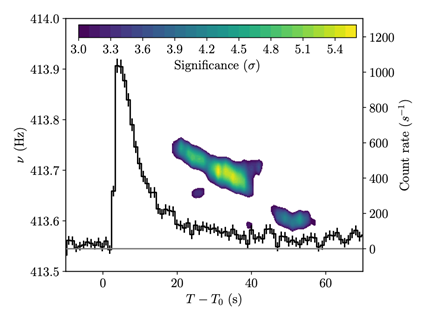
If this result is confirmed, 4U 0614+091 would become one of the most compact binary systems ever observed. It would then be a prime target for the future space-based interferometer LISA, dedicated to the observation of gravitational waves. Such systems, composed of very dense objects in tight orbits, are natural sources of gravitational waves and represent ideal laboratories for testing and calibrating this new space observatory.
These results are presented in an article accepted for publication in The Astrophysical Journal Letters.
These first results perfectly illustrate SVOM’s ambitions: to understand the most energetic phenomena in the Universe while providing high-quality data to the scientific community. By observing transient phenomena both nearby and distant, SVOM opens a new window onto the astrophysics of compact objects and confirms, from its very beginnings, its key role in exploring the violent sky.
Contact: Sébastien Le Stum (lestum@apc.in2p3.fr) & Alexis Coleiro (coleiro@apc.in2p3.fr).